Dead Harry Reid's Corrupt Cleantech Stock Market Crash Scams
When U. S. Senators Harry Reid and Dianne Feinstein realized they could each
make billions of dollars, personally, via their family stock holdings and
campaign funds, they didn't waste a minute stabbing their own constituents
in the back to get at that cash. California and Nevada Green Car Companies,
Solar Companies, Energy Technology Companies, Green Builders and Transit
Companies were hacked off at the knees because they competed with the stock
assets that Reid and Feinstein had acquired in their kick-back deals. These
other applicants were all "GREEN COMPANIES": supposedly the Democrat's
favorite things. It doesn't matter, though, how green your company was, if
it was in the path for the green cash from Tesla or Solyndra. Two of the
favored companies who paid the kick-backs to federal officials.
Harry Reid, the corrupt architect of the “nuclear option” for
judicial appointments, whose dirty, Las Vegas-style politics laid the
stage for the current atmosphere of political acrimony in Washington, DC,
departed for his final destination Tuesday after a four-year bout with
pancreati cancer.
Reid, 82, died “peacefully” and surrounded by friends, his wife, Landra,
said in a statement.
The combative former boxer-turned-lawyer was widely-acknowledged as one of
toughest dealmakers in Congress, who vexed lawmakers of both parties with
a brusque manner and this motto: “I would rather dance than fight, but I
know how to fight.”
Over a 34-year career in Washington, Reid thrived on backroom wrangling
and kept the Senate controlled by his party through two
presidents—Republican George W. Bush and Democrat Barack Obama—a crippling
recession and the Republican takeover of the House after the 2010
elections.
He was known in Washington for his abrupt style, typified by his habit of
unceremoniously hanging up the phone without saying goodbye.
“Even when I was president, he would hang up on me,” Obama said in a 2019
tribute video to Reid.
But he will best be remembered for lowering the threshold on judicial
appointments to 50 senators after being stymied by Republican opposition
to Obama far-left appointees.
That precedent allowed his successor, Sen. Mitch McConnell, R-Ky., to do the
same for former President Donald Trump’s appointees, including three
Supreme Court justices who cleared the nomination process with
near-unanimous Democrat opposition.
Reid’s move paved the way for the current Democrat effort to permanently
end the filibuster—one of the lone tools that the Senate’s
minority party has at its disposal—as part of their bid to pass the
controversial HR1
election-stealing bill.
Two other events in Reid’s declining years helped punctuate his dubious
career as Nevada’s longest-serving member of Congress to date.
During the 2012 election, he falsely claimed on the Senate floor to have
damning evidence that GOP candidate Mitt Romney had cheated on his taxes.
The effort to cajole Romney into releasing his private financial affairs
never bore out as intended, but the stigma of it contributed to the
moderate’s perception as an out-of-touch elitist. When pressed about the
unethical scheme, Reid unapologetically boasted, “Romney
didn’t win, did he?”
But cosmic justic came to Reid in 2014, when Republicans routed Democrats
in the midterm elections, spurring Reid to announce his retirement in
2015.
At the same time, he appeared to wear an eyepatch and announced that he
had been the victim of a bathroom mishap involving an elastic exercise
band.
Rumors swirled that the episode—which blinded him in one eye as well as
leaving him with several broken ribs and bones in his face—was either
Mafia-related or was the result of a domestic tiff with his ne’er-do-well brother Larry during a
drunken New Year’s Eve brawl.
Although Reid denied the rumors, speculation
persisted that he was being less than forthcoming in his explanation for
the facial injuries.
Reid in May 2018 revealed he’d been diagnosed with pancreatic cancer and
was undergoing treatment.
Althought his legacy is one of irreparable damage to the institution of
the Senate, Democrats continued to celebrate him for his hardball tactics.
Less than two weeks ago, officials and one of his sons, Rory Reid, marked
the renaming of the busy Las Vegas airport as Harry Reid International
Airport. Rory Reid is a former Clark County Commission chairman and
Democratic Nevada gubernatorial candidate.
Neither Harry nor Landra Reid attended the Dec. 14 ceremony held at the
facility that had been known since 1948 as McCarran International Airport,
after a former U.S. senator from Nevada, Pat McCarran, and today ranks as
one of the 10 busiest airports in the U.S.
Reid’s political machine helped stave off several challenges to his own
seat—notably one in the 2010 elections, when he looked like the
underdog to tea party favorite Sharron Angle.
Ambitious Democrats, assuming his defeat, began angling for his leadership
post. But Reid miraculously defeated Angle, 50% to 45%.
As dishonest as he was, he also could be disarmingly blunt about his
motives and machinations.
“I don’t have people saying ‘he’s the greatest speaker,’ ‘he’s handsome,’
‘he’s a man about town,’” Reid told the New York Times in December that
year. “But I don’t really care. I feel very comfortable with my place in
history.”
Reid’s own personal history also shed some light on his
“ends-justifies-the-means” political philosophy.
Born in Searchlight, Nevada, to an alcoholic father who killed himself at
58 and a mother who served as a laundress in a bordello, Reid grew up in a
small cabin without indoor plumbing and swam with other children at a pool
at a local brothel.
He hitchhiked to Basic High School in Henderson, Nev., 40 miles from home,
where he met the wife he would marry in 1959, Landra Gould. At Utah State
University, the couple became members of The Church of Latter-Day Saints.
The future senator put himself through George Washington University law
school by working nights as a U.S. Capitol police officer.
At age 28, Reid was elected to the Nevada Assembly and at age 30 became
the youngest lieutenant governor in Nevada history as Gov. Mike
O’Callaghan’s running mate in 1970.
Elected to the U.S. House in 1982, Reid served in Congress longer than
anyone else in Nevada history. He narrowly avoided defeat in a 1998 Senate
race when he held off Republican John Ensign, then a House member, by 428
votes in a recount that stretched into January.
After his election as Senate majority leader in 2007, he was credited with
putting Nevada on the political map by pushing to move the state’s
caucuses to February, at the start of presidential nominating season.
That forced each national party to pour resources into a state which,
while home to the country’s fastest growth over the past two decades,
still only had six votes in the Electoral College. Reid’s extensive
network of campaign workers and volunteers twice helped deliver the state
for Obama.
Obama in 2016 lauded Reid for his work in the Senate, declaring, “I could
not have accomplished what I accomplished without him being at my side.”
The most influential politician in Nevada for more than a decade, Reid
steered hundreds of millions of dollars to the state and was credited with
almost single-handedly blocking construction of a nuclear waste storage
facility at Yucca Mountain outside Las Vegas.
He often went out of his way to defend social programs that make easy
political targets, calling Social Security “one of the great government
programs in history.″
He even notoriously advocated for junk mail in 2012,
declaring, “Seniors love getting junk mail. It’s sometimes their only way
of communicating or feeling like they’re part of the real world.”
Reid championed suicide prevention, often telling the story of his father,
a hard-rock miner who took his own life. He stirred controversy in 2010
when he said in a speech on the floor of the Nevada legislature it was
time to end legal prostitution in the state.
Democrats grumbled about his votes for a ban on so-called partial-birth
abortion and the Iraq war resolution in 2002, something Reid later said it
was his biggest regret in Congress.
He voted against most gun control bills and in 2013 after the Sandy Hook
Elementary School massacre, dropped a proposed ban on assault weapons from
the Democrats’ gun control legislation. The package, he said, would not
pass with the ban attached.
Reid’s Senate particularly chafed members of the House, both Republicans
and Democrats.
When then-House Speaker Nancy Pelosi, D-Calif., railroaded Obama’s health
care overhaul through the House in 2009, a different version passed the
Senate, and the reconciliation process floundered long enough for
Republicans to turn it into an election-year weapon they used to demonize
the California Democrat and cast the legislation as a big-government power
grab.
Obama signed the measure into law in March 2010. But angered by the
recession and inspired by the small-government tea party, voters the next
year swept Democrats from the House majority.
Reid hand-picked a Democratic candidate who won the election to replace
him in 2016, former Nevada Attorney General Catherine Cortez Masto, and
built a political dynasty in the state that helped Democrats win a series
of key elections in 2016 and 2018.
On his way out of office, he repeatedly lambasted Donald Trump, calling
him at one point “a sociopath” and “a sexual predator who lost the popular
vote and fueled his campaign with bigotry and hate.”
Reid’s guileless manner made him political enemies, however, not only in
Washington, but also in his home state, a notorious Mafia hotbed.
As head of the Nevada Gaming Commission investigating organized crime,
Reid became the target of a car bomb in 1980. Police called it an
attempted homicide. Reid blamed Jack Gordon, who went to prison for trying
to bribe him in a sting operation Reid participated in over illegal
efforts to bring new games to casinos in 1978.
Following Reid’s lengthy farewell address on the Senate floor in 2016, his
Nevada colleague Republican Dean Heller declared: “It’s been said that
it’s better to be feared than loved, if you cannot be both. And as me and
my colleagues here today and those in the gallery probably agree with me,
no individual in American politics embodies that sentiment today more than
my colleague from Nevada, Harry Mason Reid.”
The
secrecy of ES&S and its competitors has pushed politicians to seek
information on security, oversight, finances and ownership. This month, a
group of Democratic politicians sent the private equity firms that own the
major election vendors a letter asking them to disclose a range of such
information, including ownership, finances and research investments.
"The voting machine lobby, led by the biggest company, ES&S, believes
they are above the law,” said Sen. Ron Wyden, D-Ore., a member of the
Intelligence Committee who co-signed the letter. “They have not had
anybody hold them accountable even on the most basic matters.”
ES&S Chief Executive Tom Burt dismissed criticism as inevitable and
impossible to answer, but he called for greater oversight of the national
election process.
“There are going to be people who have opinions from now until eternity
about the security of the equipment, the bias of those companies who are
producing the equipment, the bias of the election administrators who are
conducting the election,” Burt said in an interview. “I can’t do anything
to affect those people’s opinions.”
“What the American people need is a system that can be audited, and then
those audits have to happen and be demonstrated to the American public,”
Burt said. “That's what will cut through the noise.”
Supply chain questions
ES&S invited NBC News journalists into its headquarters, the first
time it has done so for a national news organization. The walls were
decorated with images of the Constitution and inspirational messages about
quality control. In glass-walled rooms etched with the company’s patents,
technicians tested machines under tight security.
Burt, a native Nebraskan, has called for federal regulations that would
require voting machine companies to address some of the key questions
posed to ES&S. In June, he wrote
an op-ed asking Congress for more regulation, which would
include requirements for paper backups of individual votes, mandatory
post-election audits and more resources for the U.S. Election Assistance
Commission to speed improvements.
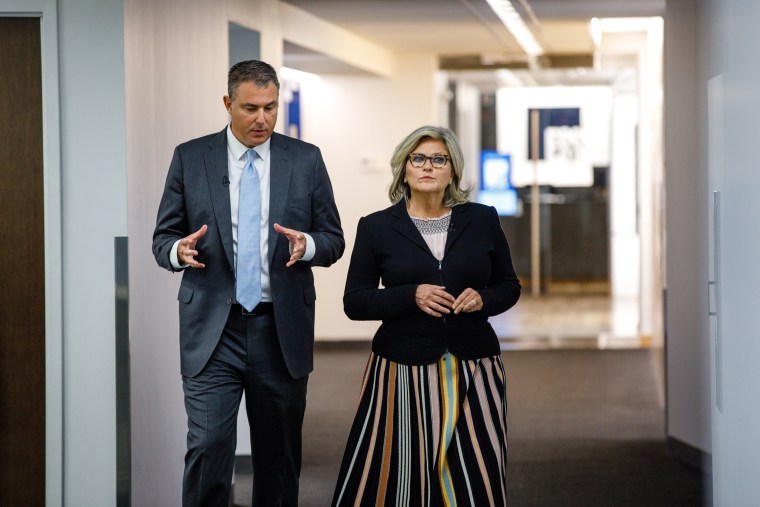
CEO Tom Burt talks with Cynthia McFadden of NBC News.Scott Morgan / for
NBC News
NBC News examined publicly available online shipping records for ES&S
for the past five years and found that many parts, including electronics
and tablets, were made in China and the Philippines, raising concerns
about technology theft or sabotage.
During the tour, Burt said the overseas facilities are “very secure.” He
said the final assembly of voting machines takes place in the U.S.
Chinese manufacturers can be forced to cooperate with requests from
Chinese intelligence officials to share any information about the
technology and therefore pose a risk for U.S. companies, NBC News analyst
Frank Figliuzzi, a former assistant director of the FBI for
counterintelligence, said. That could include intellectual property, such
as source code, materials or blueprints. There is also the concern of
machines shipped with undetected vulnerabilities or backdoors that could
allow tampering.
In a letter to NBC News, ES&S said it takes
“great care” with its foreign supply chain, including conducting risk
assessments and making on-site visits to suppliers to make sure that
components “are trusted, tested and free of malware.” It said that all of
its facilities adhere to international standards, that it manufactures in
compliance with all federal guidelines and that it follows cybersecurity
best practices.
The company says that its overseas manufacturing site has been
successfully audited by the Election Assistance Commission and that the
company conducts on-site visits of its suppliers “to ensure that
components are trusted, tested and free of malware.” “Some components
(such as surface mount capacitors, resistors, inductors and fixed logic
devices) may be sourced from China-based manufacturers,” the letter said,
referring to basic circuitry components. ES&S said it conducts quality
assurance tests on the machines.
Ownership questions
Questions about who owns the major voting machine manufacturers have
followed the industry for years. The issue took on greater urgency after
the FBI disclosed in July 2018 that a Russian oligarch had invested
in a Maryland election services firm. Officials in Maryland and
North Carolina have started questioning voting machine makers about
potential foreign ownership.Because it is privately owned, ES&S
is not legally obligated to reveal its ownership or any other details
about its finances, although Burt did confirm that the company generated
about $100 million in sales last year.
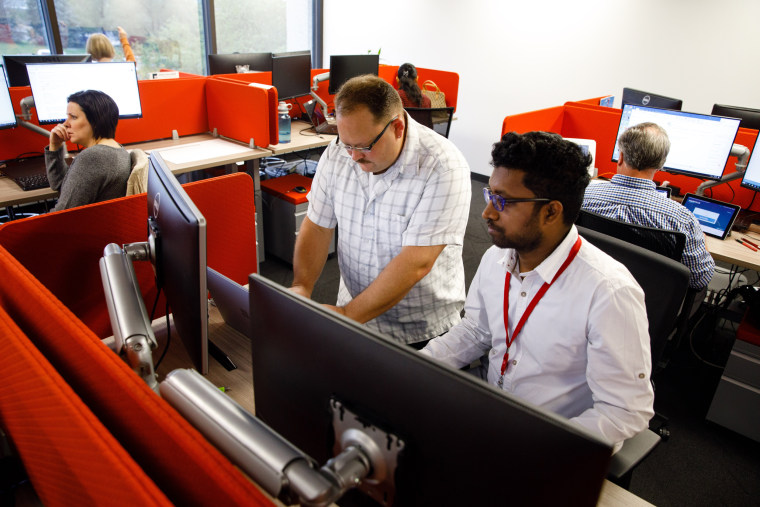
A developer and principle architect work on software.Scott Morgan / for
NBC News
But in response to questions this year from the North Carolina State Board
of Elections, ES&S disclosed which investors own more than 5 percent
of the company. They include Burt, Chief Financial Officer Tom O’Brien and
the Omaha-based private equity firm McCarthy Group, which owns a
controlling interest. The letter identified two passive investors,
Nancy McCarthy and Kenneth Stinson, who own stakes of more than 5 percent
in McCarthy Group.
ES&S said McCarthy Group’s bylaws prevented it from revealing other
individual investors, but it affirmed that they are all U.S. citizens or
trusts or corporations owned by Americans. The company offered to pay for
an independent auditor to verify that all the investors are Americans. NBC
News declined, as citizenship itself wouldn’t answer other potential
questions, including political affiliations or other conflicts of
interest.McCarthy Group did not respond to NBC News’ requests for comment.
Testing questions
Virtually no laws govern the cybersecurity aspects of voting machine
technologies. But ES&S points to its voluntary efforts to improve
voting machine security, most notably a new program with the Energy
Department’s Idaho National Labs, the same federal facility that tests the
power grid and nuclear power generators. ES&S machines underwent eight
weeks of vulnerability testing and penetration by government hackers.
Chris Wlaschin, head of systems security for ES&S, said at a Homeland
Security cybersecurity summit in Washington in September that the
company’s machines are not prone to a remote attack over the internet. But
he added that someone with enough time and access could make a machine
“inoperative or unusable.”
Although Wlaschin said the company would release an executive summary of
the government testing, the company recently said it has nothing for
“external release.” It said recommendations from the tests would be
incorporated into “future voting system releases.” Wyden said he was
concerned by the company’s foreign parts supply and was working on
legislation to limit it. “What you have found is particularly important
because of the China connection,” he said.
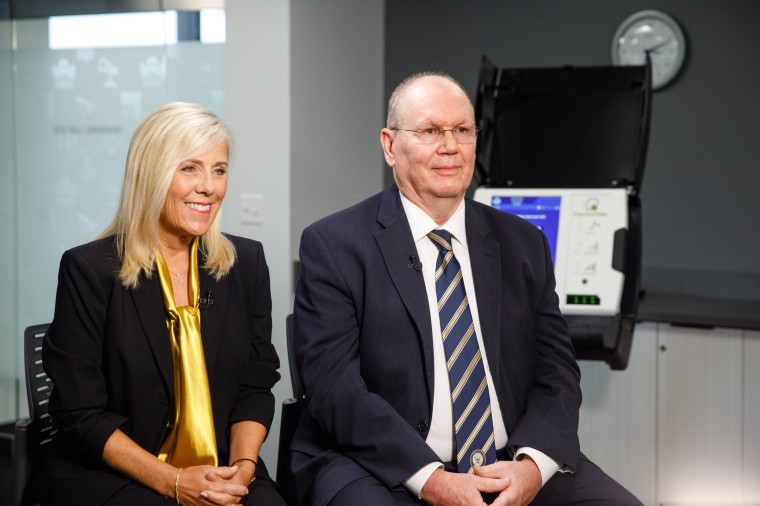
Senior Vice President of Government Relations Kathy Rogers and Vice
President of Systems Security Chris Wlaschin.Scott Morgan / for NBC
NewsWyden is also eager to see the Idaho National Lab findings.
“They’re claiming that the Department of Homeland Security has been
working with them. I’m going to ask for this information on the basis of
your report within 10 days,” he said.
Eddie Perez, global director of technology development for the Open Source
Election Technology Institute, a nonprofit election technology research
group with which NBC News has partnered since 2016, said the lack of
oversight is problematic.
“The way people vote is managed by a couple of entities that people don’t
know a lot about, and that creates risks for the country,” he said. When
it comes down to the essentials, voting machine makers “behave based on
the level of regulation they have,” Perez said.“They have to check the
boxes,” he added. “But once they’ve done that, they focus on selling their
product.” https://www.nbcnews.com/news/all/chinese-parts-hidden-ownership-growing-scrutiny-inside-america-s-biggest-n1104516
They were concerned about hacking back in 2019 but magically those
concerns have evaporated.
In a Jan. 9 House Administration Committee hearing, three of the
largest U.S. voting system manufacturers said they would support a range
of new regulatory and reporting requirements, but at least one election
security expert said that may not be enough.
Among the potential requirements being floated are that states purchase
voting machines with paper records and conduct post-election audits for
every vote cast, publicly report on equipment-related security risks and
follow new federally crafted guidelines for how to best set up their
manufacturing supply chains.
The three companies -- Election Systems and Software, Dominion Voting
Systems and Hart InterCivic -- have a history of resisting outside
scrutiny of their products, but company representatives expressed openness
to new federal regulations to bolster confidence about the security of
their products.
"I think we would support any requirements that [apply] to all vendors in
our industry that would help educate users of our system and anyone who
interacts with them," said E&S CEO Tom Burt. https://gcn.com/articles/2020/01/10/voting-equipment-security-requirements.aspx
What sort of banana republic has to farm out the counting of the votes to
a foreign country?
Catherine Engelbrecht, founder of True the Vote, noted that many states commissioned a
foreign company based in Spain to provide various election services —
including online voting — in the 2020 presidential election.
Engelrecht offered her remarks on Wednesday’s edition of SiriusXM’s Breitbart
News Daily with host Alex Marlow.
What
about the connection to the Clinton Foundation?
In
2014, Dominion Voting committed to providing emerging and post-conflict
democracies with access to voting technology through its philanthropic
support to the DELIAN Project, as many emerging democracies suffer from
post-electoral violence due to the delay in the publishing of election
results. Over the next three years, Dominion Voting will support
election technology pilots with donated Automated Voting
Machines
(AVM), providing an improved electoral process, and therefore
safer
elections.
As a large number of election staff are women, there will be an emphasis
on training women, who will be the first to benefit from the skills
transfer training and
use
of AVMs. It is estimated that 100 women will directly benefit from
election technology skills training per pilot election.
Of
course the are saying that Diane Feinstein and Nancy
Pelosi
are squeaky-clean.
Dominion
Voting Systems rebuked claims that the company has a financial
relationship with the husband of Sen. Dianne Feinstein and that the
company
manipulated the results of the 2020 election.
In
Bullet-point, the charges against the Feinstein Family Cartel, in the
Cleantech Crash Corruption Case include:
Feinstein was the promoter, lobbyist and beneficiary of the side-by-side
(on the same plot of land) Tesla and Solyndra government hand-out
funding scandal.
Feinstein’s daughter, Kathryn, documented illicit actions by her mother,
while in
social habitation with the applicants
While in the Mayor’s office, Bruce Brugman, publisher of the top San
Francisco
weekly newspaper: The San Francisco Bay Guardian, documented and
published nearly 100 corruption charges against Feinstein. Local law
enforcement efforts, against Feinstein were nearly impossible, at the
time, according to Bay Guardian staff because local politicians and
authorities had been paid off by James Bronkema, David Rockefeller’s
“bag man” and John Molinari, the local mob
“bag man”. Ex-Guardian staff have suggested that associates of one of
those two Feinstein financing clans had, possibly arranged the George
Moscone
assassination in order to position Feinstein for higher office
Herb Newman, of Sausalito, California; Feinstein’s relative, was awarded
the staffing contracts for Tesla and Solyndra based on Feinstein’s
say-so, in direct conflict of interest
Feinstein, and her Chief of Staff, warned applicant’s about attempting
to use the NUMMI auto factory, which she was covertly placing Tesla in
and Solyndra next to. Tesla had already publicly rejected the NUMMI
building as “unusuable” in the press, yet Feinstein talked Tesla into
using it so that her husband’s company could profit from it and so she
could arrange kick-backs to Tesla, more easily
Feinstein worked with Senator Harry Reid on the Cleantech Scams.
Together, by helping White House staff and financiers manipulate the
program, they made over $50 Million in personal profits at taxpayer
expense
Feinstein staff worked for and were compensated by, Tesla and Solyndra.
In some cases Feinstein staff and Tesla staff were interchangeable, in
direct conflict-of-interest
Feinstein’s husband had financial interests in the railroad property
adjacent to the Tesla and Solyndra buildings. Feinstein later got him
the entire California high speed rail contract
The Feinstein family owned the construction company which Tesla and
Solyndra, used. They were given no-bid contracts
Feinstein, and her husband worked with White House staff under Rahm
Emanual and Silicon Valley campaign financier John Doerr and associates
involved with Kleiner Perkins to conduit bribes, and campaign financing,
as stock warrants and positions
Feinstein associate: Roger Boas, was arrested for involvement in a child
prostitution ring for political pedophiles, and for embezzling money for
the Moscone Convention Center construction
The Feinstein Family held war profiteering contracts in Afghanistan,
Bolivia and other regions which held the exclusive mining contracts for
Solyndra and Tesla chemicals
After Solyndra was raided by the FBI and went bankrupt, costing
taxpayers over half a trillon dollars in losses, the Feinstein Cartel
used the tax write-off losses to make a profit, via tax form
manipulations on the tax-write-off losses from the
Solyndra crash
Feinstein, and her staff, sabotaged other applicants who were competing
for the
same funds as Tesla and Solyndra
Even after Solyndra went bankrupt, the Feinstein family continued to
profit off of
the Solyndra scandal by re-leasing the buildings and collecting real
estate profits
Feinstein’s family ran the property sales and leasing contracts for the
Tesla and
Solyndra buildings
Gary D. Conley, a Bay Area solar and Hydrogen company CEO, whistle-blew
on the corruption at Tesla and Solyndra and was later found with a
bullet in his head behind a Northern California Air Force base. His
family, and friends, charge that is death was “suspicious”
Feinstein’s family and associates held stock in Tesla, Solyndra and
other “Clean Tech” companies, which they acquired at key
pre-announcement points, most likely based on insider information and
the payola from bribes provided as stock warrants
Feinstein, and her staff told Fremont, California city officers to not
engage in discussions with competing applicants
Although other, competing, applicants had been in written discussions,
and negotiations, with senior executives at Toyota for the use of the
NUMMI plant, Feinstein warned Toyota that only Tesla would be supported
for the use of the plant. This was before anyone from Tesla had
contacted anyone from Toyota, the owners of the plant, and after Elon
Musk had been published in the press saying that Tesla could have no use
for the building.
Conclusion:
The facts, evidence, testimony and surveillance clearly prove that
Dianne Feinstein used her public office to stage a corruption program to
provide public cash and resources to herself and her family for covert
profits at taxpayer expense. She used her office to assist in the
attacks and sabotage of U.S. companies who were competing for the same
funds that she was manipulating. https://richmondrefinerycancer.wordpress.com/the-corruption-of-senator-feinstein/
...This anecdote provides significantly more questions than answers. For
starters: Who was the spy? For how long was the spy under surveillance?
What information about “local politics” was the spy passing back to
China? Just how close was the spy to the senator? Did law enforcement
officials sweep vehicles and other areas for listening devices? Was
there an investigation into whether others in the senator’s circle may
have been coordinating with Beijing?
Did the senator expose herself to potential blackmail, or the public to
danger through leakage of sensitive, highly classified information? Is
firing really the proper punishment for providing political intelligence
to a foreign power?... https://thefederalist.com/2018/08/08/sen-dianne-feinsteins-ties-china-go-way-deeper-alleged-office-spy/
From
Glenn Greenwald's old newspaper, the Intercept in 2015.
CBRE, a
giant real estate company partially owned by Sen. Dianne Feinstein’s
husband, Richard Blum, is costing the U.S. Postal Service millions of
dollars a year in lease overpayments, and its exclusive contract should
be immediately canceled, the service’s inspector general has
found. Eyebrows
rose when the USPS made the contract
with CBRE in June 2011 for all real estate transactions. Blum
chaired CBRE at the time; he stepped
down last year, but remains a director and a major shareholder.
Feinstein, D-Calif., has always denied involvement in the deal, which
proved lucrative as the cash-strapped Postal Service looked
to its excess real estate to finance operations.
The contract enables CBRE to market and sell properties, and conduct
negotiations for leases of postal buildings. Prior to the contract, USPS
negotiated leases directly with landlords. Now, CBRE often represents
both the Postal Service and the landlord in negotiations, known as “dual
agency transactions.”